When Excel is the Right Tool
Excel is not the problem — misuse is.
It works extremely well when your business is still simple and coordination overhead is low.
You’ll likely do just fine with Excel if:
- Your team is small (under ~10–15 people)
- Operations are straightforward
- Transaction volume is low
- There are no strict approval workflows
- Flexibility matters more than structure
Excel works well when coordination is simple and decisions are informal.
At this stage, introducing ERP too early can actually slow you down.
When Excel Starts Slowing You Down.
Excel rarely “breaks” — it gradually becomes harder to manage.
Watch for these signals:
- Multiple versions of the same file floating across teams
- Heavy manual reconciliation between sheets
- Confusion around approvals and responsibilities
- Inconsistent or unreliable data
- Dependency on specific individuals who “manage” files
- Delays in reporting and decision-making
Excel doesn’t fail suddenly — it slowly turns into a coordination bottleneck.
And that bottleneck compounds as you grow.
What ERPNext Does Differently
This is where ERPNext changes the game.
Instead of scattered files, ERPNext creates a structured system where operations follow defined paths.
Here’s what shifts:
- Centralized data — one source of truth
- Role-based access — controlled visibility and accountability
- Workflow-driven approvals — no ambiguity in processes
- Real-time reporting — decisions based on live data
- Defined processes — consistency across teams
ERPNext doesn’t just store data — it enforces how work flows through the organization.
That’s the fundamental difference.
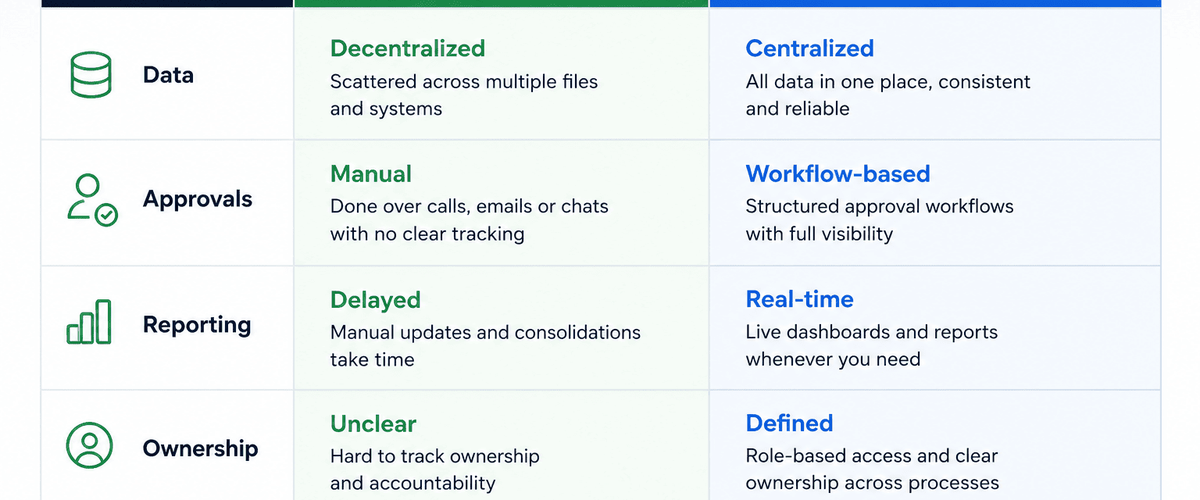
ERPNext vs Excel — Key Differences
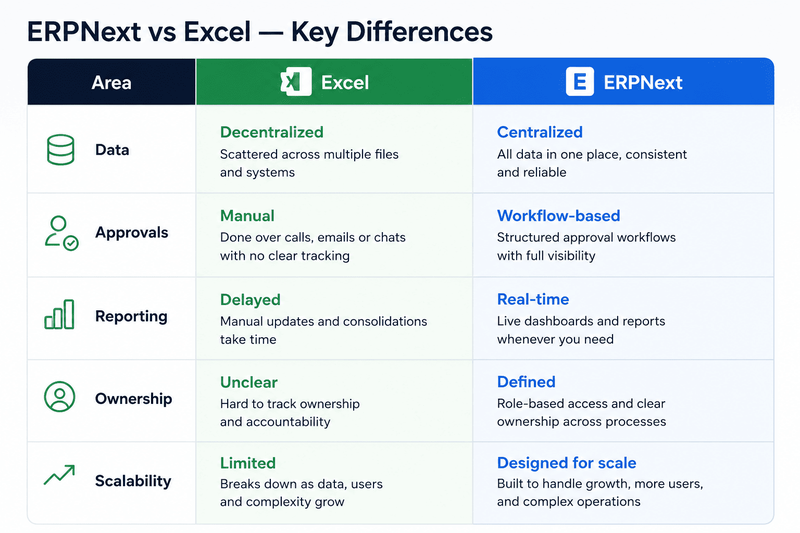
When comparing ERPNext vs Excel, this is where the real distinction lies — not in features, but in how work is managed.
When Should You Move from Excel to ERPNext?
There’s no perfect moment — but there are clear triggers.
You should seriously consider moving from Excel to ERP when:
- Your team grows beyond 20–30 people
- You have multiple departments interacting
- Inventory becomes a core part of operations
- You operate across multiple locations
- Reconciliation becomes frequent and time-consuming
- Leadership lacks real-time visibility
The right time to implement ERP is before operational chaos becomes normal.
Waiting too long makes the transition harder.
A Common Mistake Businesses Make
Many businesses get the timing wrong.
They either:
- Jump into ERP too early without clear processes
- Or wait too long and try to fix chaos with software
Here’s the reality:
ERP doesn’t fix unclear processes — it exposes them faster.
That’s why preparation matters more than the tool itself.
How to Transition from Excel to ERPNext
A smooth transition is not about switching tools — it’s about redesigning how your business operates.
A practical approach:
- Map your current processes
- Identify bottlenecks and inefficiencies
- Define clear workflows and responsibilities
- Clean and structure your existing data
- Implement ERPNext in phases (not all at once)
This reduces risk and ensures adoption across teams.
Thinking About Moving Beyond Excel?
If your team is spending more time coordinating work than actually executing it, it may be time to rethink your systems.
We work with growing businesses to design ERPNext systems that reflect how operations actually run — not just how software is configured.
If you're unsure whether it's the right time, a short discussion can help clarify your next step.
👉 [Book a consultation]
👉 [Explore our homepage]
👉 Read: Why ERP Implementations Fail